
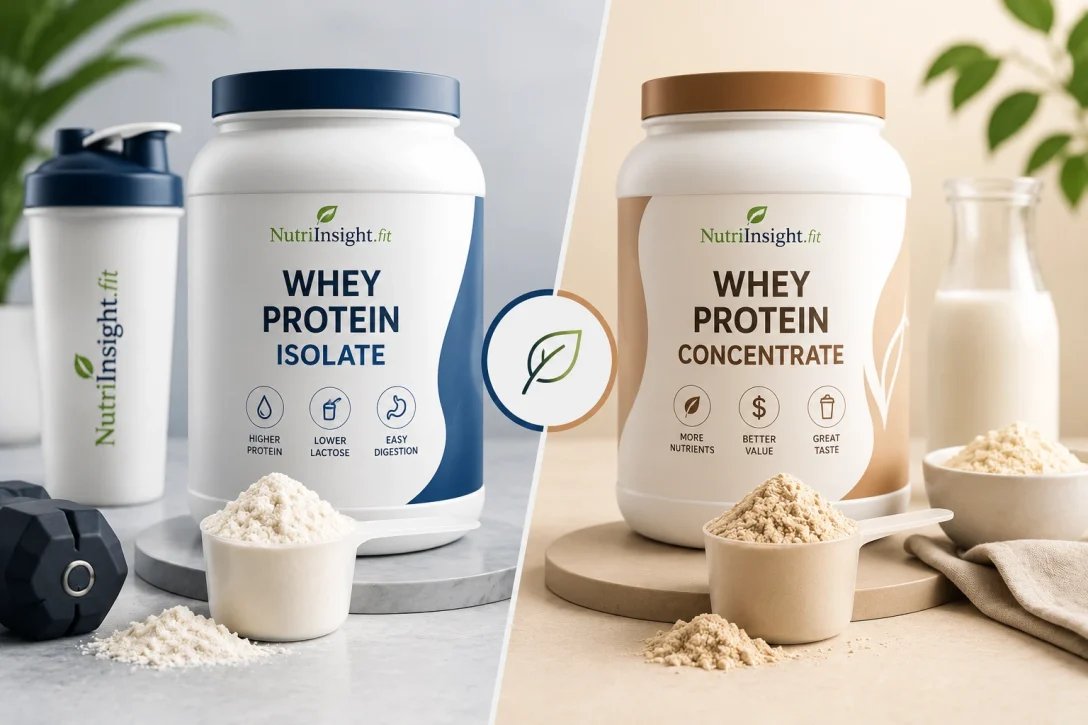

Whey isolate vs concentrate is one of the most common comparisons people make when shopping for protein powder. Although both are high-quality sources of complete protein, they differ in protein content, lactose, calories, fat, and price. Understanding these differences will help you choose the best option for your fitness goals.
At first glance, they look almost identical. Both support muscle growth, recovery, and daily protein intake. However, there are important differences in protein concentration, lactose content, calories, digestion, and price that can influence which one is the better choice for your fitness goals.
The good news is that both are excellent sources of high-quality protein. Neither is universally “better”—the right option depends on your budget, dietary needs, and training objectives.
In this guide, we’ll compare whey protein isolate vs concentrate side by side, explain how they’re made, review the scientific evidence, and help you decide which one deserves a place in your nutrition plan.
Looking for product recommendations? Read our Best Whey Protein Powders guide. (Internal Link)
Whey Protein Isolate vs Concentrate: Quick Comparison
| Feature | Whey Protein Isolate | Whey Protein Concentrate |
|---|---|---|
| Protein Content | 90% or more | 70–80% |
| Lactose | Very Low | Moderate |
| Fat | Very Low | Higher |
| Carbohydrates | Very Low | Slightly Higher |
| Calories | Slightly Lower | Slightly Higher |
| Digestion | Fast | Fast |
| Best For | Lactose intolerance, cutting, lean muscle | Budget, general fitness, bulking |
| Cost | More Expensive | More Affordable |
The Short Answer
Choose whey protein isolate if you:
- Want the highest protein content
- Are lactose sensitive
- Are cutting calories
- Prefer leaner nutrition
Choose whey protein concentrate if you:
- Want excellent value
- Don’t have lactose issues
- Are building muscle on a budget
- Prefer a creamier taste
What Is Whey Protein?
Whey protein is a complete protein naturally found in milk. During cheese production, milk separates into curds and liquid whey. The liquid is filtered, dried, and processed into whey protein powder.
Whey contains all nine essential amino acids and is naturally rich in branched-chain amino acids (BCAAs), particularly leucine, which plays a key role in stimulating muscle protein synthesis. The International Society of Sports Nutrition Position Stand on Protein and Exercise identifies whey protein as one of the highest-quality protein sources for supporting muscle protein synthesis and recovery in physically active individuals.
Because it digests rapidly, whey protein has become one of the most researched and widely used sports nutrition supplements worldwide. For a broader overview of dietary protein and essential amino acids, the Harvard T.H. Chan School of Public Health Protein Guide provides an excellent evidence-based resource.
What Is Whey Protein Concentrate?
Whey protein concentrate (WPC) is the least processed form of whey protein.
After filtration, some naturally occurring fats, carbohydrates, lactose, and bioactive compounds remain.
Most concentrates contain:
- 70–80% protein
- Small amounts of fat
- Small amounts of carbohydrates
- More lactose than isolate
Because it undergoes less processing, many people appreciate its richer flavor and creamy texture.
Pros
- Lower price
- Great taste
- Contains beneficial milk compounds
- Excellent for muscle building
Cons
- More lactose
- Slightly higher calories
- Lower protein percentage
What Is Whey Protein Isolate?
Whey protein isolate undergoes additional filtration to remove most of the fat, carbohydrates, and lactose.
The result is a much purer protein powder that usually contains 90% or more protein by weight.
Because of the additional processing, isolate contains:
- Higher protein concentration
- Less lactose
- Less fat
- Fewer carbohydrates
This makes it especially popular among athletes during fat-loss phases and people who struggle with lactose digestion.
Pros
- Highest protein content
- Very low lactose
- Low calorie
- Excellent for cutting
Cons
- Higher cost
- Slightly thinner texture
- Less creamy taste
Protein Content: Whey Protein Isolate vs Concentrate
When comparing whey isolate vs concentrate, the most noticeable difference is the amount of protein per serving. Because whey protein isolate undergoes additional filtration, it contains a higher percentage of protein while removing more fat, carbohydrates, and lactose.
A typical serving provides:
| Nutrient | Whey Protein Isolate | Whey Protein Concentrate |
|---|---|---|
| Protein | 25–27 g | 22–25 g |
| Fat | Very low | Slightly higher |
| Carbohydrates | Very low | Slightly higher |
| Lactose | Minimal | Higher |
Although whey protein isolate provides slightly more protein gram-for-gram, the real-world difference is usually only 2–4 grams per serving. Therefore, for most healthy adults, this small difference is unlikely to have a significant impact on muscle growth or recovery if overall daily protein intake is sufficient.
According to the International Society of Sports Nutrition (ISSN), meeting your total daily protein needs is far more important than choosing between different high-quality protein sources. Read the full position stand here: (1)
Additionally, you can compare the nutritional composition of different whey protein products using the USDA FoodData Central database: (2)
If your primary goal is maximizing protein while minimizing calories, whey isolate may be the better choice. However, if you’re looking for a more affordable protein powder with excellent muscle-building benefits, whey concentrate remains an outstanding option.
Lactose Content
This is where isolate clearly wins.
Since additional filtration removes most of the lactose, whey isolate is often tolerated by people with mild lactose intolerance.
Concentrate still contains lactose, which may cause:
- Bloating
- Gas
- Stomach discomfort
if you’re lactose sensitive.
If dairy regularly upsets your stomach, isolate is usually worth the extra money.
Need dairy-free alternatives? Check out our guide to the Best Dairy-Free Protein Drinks.
Calories, Fat and Carbohydrates
Although the differences are small, they matter during a calorie deficit.
Whey Isolate
- Lower calories
- Lower fat
- Lower carbs
Whey Concentrate
- Slightly higher calories
- More healthy milk fats
- Slightly higher carbohydrate content
For someone trying to lose body fat while maximizing protein intake, isolate offers a small nutritional advantage.
Muscle Growth: Is Isolate Better?
Surprisingly, not necessarily.
Research consistently shows that both whey isolate and whey concentrate effectively stimulate muscle protein synthesis.
As long as you’re consuming enough total protein throughout the day and following a progressive resistance training program, muscle-building results are remarkably similar.
The slight difference in protein percentage rarely translates into noticeably greater gains.
Training quality, total protein intake, calorie intake, sleep, and consistency matter far more.
Recovery After Exercise: Whey Protein Isolate Vs Concentrate
Both whey protein isolate and whey protein concentrate are rapidly digested, making them excellent choices for post-workout recovery. They provide all nine essential amino acids, including a high concentration of branched-chain amino acids (BCAAs), particularly leucine, which plays a key role in stimulating muscle protein synthesis after exercise.
Research has consistently shown that whey protein supplementation can support:
- Muscle recovery after training
- Increased strength over time
- Lean muscle growth
- Reduced exercise-induced muscle soreness
- Faster recovery between workouts when combined with resistance training
Although whey protein isolate contains slightly more protein per serving, current evidence suggests that neither whey protein isolate nor concentrate consistently outperforms the other for muscle recovery or muscle growth in healthy individuals, provided that total daily protein intake is adequate.
The International Society of Sports Nutrition (ISSN) states that consuming sufficient high-quality protein throughout the day is more important for optimizing recovery and muscle adaptation than choosing one form of whey over another. You can read the full position stand here:
https://jissn.biomedcentral.com/articles/10.1186/s12970-017-0177-8
Similarly, the American College of Sports Medicine (ACSM) recommends adequate protein intake, distributed across the day, to support recovery, muscle repair, and athletic performance:
https://www.acsm.org/education-resources/trending-topics-resources/nutrition
Ultimately, the better choice depends on your individual needs. If you’re looking for the highest protein content with minimal fat, carbohydrates, and lactose, whey protein isolate may be preferable. However, if you’re seeking a more affordable option that delivers comparable recovery benefits, whey protein concentrate remains an excellent choice.
Which Is Better for Weight Loss: Whey Protein Isolate Vs Concentrate?
If your goal is fat loss, isolate has a slight edge.
Because it provides:
- More protein
- Fewer calories
- Less fat
- Less carbohydrate
it allows you to maximize protein intake while keeping calories lower.
That said, concentrate can still be an excellent choice if it fits within your calorie goals.
Remember, no protein powder causes weight loss by itself. A calorie deficit remains the most important factor.
Read next: Best Protein Powder for Weight Loss (Internal Link)
Which Is Better for Muscle Gain: Whey Protein Isolate vs Concentrate?
For muscle gain, concentrate often provides the better overall value.
You’ll receive nearly identical muscle-building benefits while spending less money.
Since gaining muscle usually requires eating enough calories anyway, the slightly higher fat and carbohydrate content isn’t a disadvantage for most people.
Is Whey Isolate Worth the Extra Money?
That depends.
Whey isolate is worth it if:
- You’re lactose intolerant
- You’re preparing for competition
- You’re cutting body fat
- You want maximum protein per serving
Whey concentrate offers better value if:
- You’re healthy
- You’re building muscle
- You’re on a budget
- You don’t experience digestive issues
For many recreational gym-goers, concentrate provides nearly all the benefits at a significantly lower price.
Who Should Choose Whey Protein Isolate?
Whey protein isolate is an excellent choice if your goal is to maximize protein intake while keeping calories, carbohydrates, and fat to a minimum. Because it undergoes additional filtration, it typically contains 90% or more protein by weight. As a result, it’s one of the purest protein supplements available today.
For Weight Loss and Lean Muscle
Choose whey protein isolate if you:
- Want the leanest protein available with minimal calories.
- Follow a calorie-restricted diet and need to maximize protein intake.
- Are cutting body fat while maintaining lean muscle mass.
- Want a supplement with a high protein-to-calorie ratio.
Additionally, whey isolate can help you stay within your daily calorie target without sacrificing protein intake, making it a popular option during fat-loss phases.
For Better Digestion
Whey protein isolate is also ideal if digestion is a concern.
Choose it if you:
- Experience mild lactose sensitivity.
- Prefer a supplement that is lower in lactose than whey concentrate.
- Want slightly faster digestion after workouts.
Because most of the lactose is removed during processing, many people find whey isolate easier on their stomach. However, those with a true dairy allergy should still avoid whey-based products.
For Low-Carb or High-Protein Diets
If you’re following a specific nutrition plan, whey isolate may be the better fit.
It’s a great option if you:
- Prefer low-fat and low-carbohydrate supplements.
- Follow a ketogenic, low-carb, or macro-focused diet.
- Need an efficient way to reach your daily protein goals.
Furthermore, many quality whey isolates contain very few ingredients beyond protein, flavoring, and sweeteners. Therefore, they can fit well into a clean eating plan.
Is Whey Isolate Worth the Higher Price?
Although whey protein isolate usually costs more than whey concentrate, the extra filtration provides higher protein content and lower levels of fat, carbohydrates, and lactose. Consequently, many athletes, bodybuilders, and health-conscious individuals consider the higher price worthwhile.
Ultimately, whey isolate is best for anyone who wants premium-quality protein with minimal extras, especially during cutting phases or when every gram of protein and every calorie matter.
Who Should Choose Whey Protein Concentrate?
Whey protein concentrate is an excellent choice for most healthy adults. While it contains slightly less protein than whey isolate, it still provides all the essential amino acids needed to support muscle growth, recovery, and overall health. Because it undergoes less processing, concentrate also tends to be more affordable, making it a practical option for everyday use.
You should consider whey protein concentrate if you:
You’re Looking for the Best Value
If you’re using protein powder every day, cost can add up quickly. Whey protein concentrate is typically less expensive than whey isolate while still delivering high-quality protein. For most recreational gym-goers, the small difference in protein content isn’t enough to justify paying a premium for isolate.
You’re Trying to Build Muscle
For muscle gain, the most important factors are consuming enough total protein, training consistently, and eating enough calories to support growth. Whey concentrate provides plenty of high-quality protein and naturally contains branched-chain amino acids (BCAAs), including leucine, which helps stimulate muscle protein synthesis. As a result, it remains one of the most popular choices for bulking and strength training.
You Enjoy a Richer, Creamier Taste
Because whey concentrate retains a small amount of milk fat, many people find it has a smoother texture and creamier flavor than whey isolate. If taste is important to you, concentrate may make it easier to stick to your daily protein goals.
You Don’t Have Lactose Intolerance
Although whey concentrate contains more lactose than isolate, many people digest it without any issues. If you regularly consume dairy products such as milk, yogurt, or cheese without discomfort, whey concentrate is likely to be a suitable option.
You Want an Affordable Daily Protein Source
Protein powder is designed to supplement your diet, not replace whole foods. If your goal is simply to increase your daily protein intake, whey concentrate offers an effective and budget-friendly solution. It works well as a post-workout shake, a breakfast addition, or a convenient snack between meals.
For most people, whey protein concentrate strikes an excellent balance between quality, taste, and affordability, making it the best all-around choice for everyday use.
Whey Protein Isolate vs Concentrate FAQs
| Question | Answer |
|---|---|
Is whey isolate healthier than concentrate? |
Not necessarily. Both whey protein isolate and whey protein concentrate are high-quality, complete proteins that provide all nine essential amino acids. Whey isolate simply contains more protein per serving and less lactose, fat, and carbohydrates. |
Does whey isolate build more muscle? |
Current research indicates that both whey protein isolate and concentrate support muscle growth equally well when total daily protein intake and resistance training are adequate. |
Is whey concentrate bad for lactose intolerance? |
It depends on the severity of your lactose intolerance. People with mild lactose sensitivity may tolerate whey concentrate, while those with more severe intolerance often find whey isolate or a dairy-free protein powder easier to digest. |
Which has fewer calories: whey protein isolate vs concentrate? |
Whey protein isolate generally contains fewer calories because additional processing removes most of the fat and carbohydrates while increasing the protein concentration. |
Which tastes better: Whey Protein Isolate vs Concentrate? |
Many people prefer the richer, creamier taste of whey protein concentrate because it retains slightly more fat and naturally occurring milk components than whey isolate. |
| Which is better for weight loss? | Whey protein isolate is often preferred during weight-loss phases because it provides more protein with fewer calories, carbohydrates, and fat. However, whey concentrate can be just as effective if it fits within your daily calorie and protein goals. |
| Is whey protein isolate worth the extra cost? | If you want the highest protein content with minimal lactose and calories, whey isolate may be worth the higher price. However, whey concentrate offers excellent nutritional value and is often the better choice for people on a budget. |
Final Verdict
When comparing whey protein isolate vs concentrate, there’s no universal winner.
Choose whey protein isolate if you prioritize maximum protein, minimal lactose, and lower calories. It’s ideal for cutting phases, lactose-sensitive individuals, and anyone seeking the leanest protein option.
Choose whey protein concentrate if you’re looking for excellent value, a richer taste, and an effective protein supplement for building muscle without paying a premium.
Ultimately, the best protein powder is the one you’ll use consistently while meeting your daily protein needs and supporting your training goals.




Pingback: Best Time to Drink Protein Shakes (2026 Guide) - Nutra Insight