
Should you drink a protein shake before or after workout sessions? It’s one of the most common questions among gym-goers. While some believe drinking protein before exercise improves performance, others swear by a post-workout shake.
Research suggests that both approaches can effectively support muscle growth and recovery, provided your overall daily protein intake is adequate.In fact, studies published by the International Society of Sports Nutrition (ISSN) indicate that consuming enough high-quality protein throughout the day has a greater impact on building muscle than the precise timing of a protein shake.
In this guide, we’ll examine what the latest research says about muscle growth, recovery, strength, and weight loss to help you decide which timing works best for your goals. If you’re looking for a complete guide covering protein timing throughout the day—including mornings, evenings, before bed, and rest days—read our Best Time to Drink Protein Shakes guide.
In this article, we’ll focus specifically on one question:
Is it better to drink a protein shake before or after your workout?
Quick Answer
For most people, drinking a protein shake either before or after a workout produces similar results—as long as you consume enough high-quality protein throughout the day.
If you’ve eaten a protein-rich meal within the last two to three hours before training, there’s little urgency to drink a shake immediately afterward. However, if you train on an empty stomach or haven’t eaten for several hours, consuming protein soon after your workout can help stimulate muscle protein synthesis and support recovery.
The best choice depends on your routine rather than a universal rule.
Does Protein Timing Really Matter?
For years, fitness enthusiasts believed there was a narrow “anabolic window” lasting only 30 minutes after exercise. According to this theory, missing that window meant missing your opportunity to maximize muscle growth.
Scientists now understand that total daily protein intake is the biggest factor influencing muscle growth and recovery. Protein timing still matters, but it plays a supporting role rather than being the deciding factor. This conclusion is supported by the International Society of Sports Nutrition (ISSN), which states that total daily protein intake is the primary driver of exercise-induced muscle adaptations, while nutrient timing offers additional—but smaller—benefits in certain situations.
Source: (1)
Think of it this way:
- Daily protein intake is the foundation.
- Progressive strength training provides the stimulus.
- Protein timing helps optimize the process.
If you consistently eat enough protein throughout the day, whether your shake comes slightly before or after training becomes much less important.
That said, strategic timing can still provide benefits depending on your workout schedule and goals.
Protein Before Your Workout
Drinking a protein shake before training supplies your muscles with amino acids that remain available during exercise.
Rather than waiting until you’ve finished lifting weights, your body already has the building blocks needed for muscle repair.
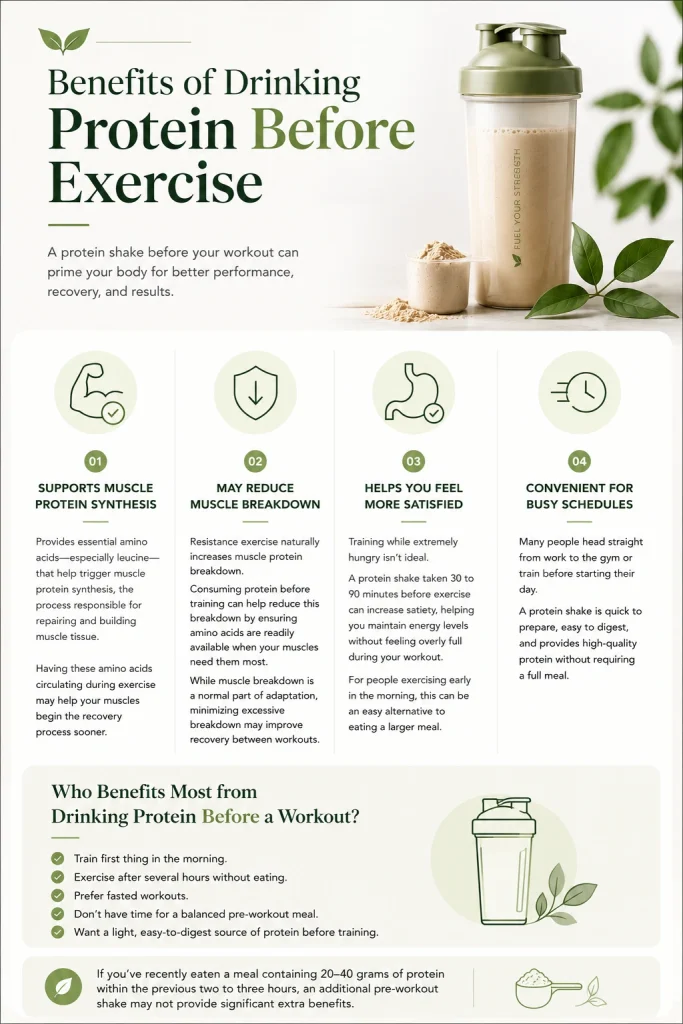
Benefits of Drinking Protein Before Exercise
Supports Muscle Protein Synthesis
Protein provides essential amino acids—especially leucine—that help trigger muscle protein synthesis, the process responsible for repairing and building muscle tissue after resistance training.
Having these amino acids circulating during exercise may help your muscles begin the recovery process sooner.
May Reduce Muscle Breakdown
Resistance exercise naturally increases muscle protein breakdown.
Consuming protein before training can help reduce this breakdown by ensuring amino acids are readily available when your muscles need them most.
While muscle breakdown is a normal part of adaptation, minimizing excessive breakdown may improve recovery between workouts.
Helps You Feel More Satisfied
Training while extremely hungry isn’t ideal.
A protein shake taken 30 to 90 minutes before exercise can increase satiety, helping you maintain energy levels without feeling overly full during your workout.
For people exercising early in the morning, this can be an easy alternative to eating a larger meal.
Convenient for Busy Schedules
Many people head straight from work to the gym or train before starting their day.
In these situations, a protein shake is quick to prepare, easy to digest, and provides high-quality protein without requiring a full meal.
Who Benefits Most from Drinking Protein Before a Workout?
Pre-workout protein is especially beneficial if you:
- Train first thing in the morning.
- Exercise after several hours without eating.
- Prefer fasted workouts.
- Don’t have time for a balanced pre-workout meal.
- Want a light, easy-to-digest source of protein before training.
If you’ve recently eaten a meal containing 20–40 grams of protein within the previous two to three hours, an additional pre-workout shake may not provide significant extra benefits.
Best Protein Options Before a Workout
Not every protein digests at the same rate.
Here’s how common options compare:
| Protein Source | Digestion Speed | Best Before Workout? |
|---|---|---|
| Whey Protein Isolate | Very Fast | ⭐⭐⭐⭐⭐ |
| Whey Protein Concentrate | Fast | ⭐⭐⭐⭐⭐ |
| Plant-Based Protein Blend | Moderate | ⭐⭐⭐⭐☆ |
| Greek Yogurt | Moderate | ⭐⭐⭐⭐☆ |
| Cottage Cheese | Slow | ⭐⭐⭐☆☆ |
Whey protein remains the most popular option because it digests quickly and contains a high concentration of essential amino acids.
If you’re unsure which type of whey to choose, check out our guide comparing Whey Protein Isolate vs Concentrate.
How Long Before a Workout Should You Drink a Protein Shake?
Most experts recommend consuming a protein shake 30 to 90 minutes before exercise.
This gives your body enough time to begin digesting the protein without making you feel overly full during your workout.
The exact timing depends on:
- Your digestive comfort.
- The size of your shake.
- Whether you’re combining it with carbohydrates.
- The intensity of your workout.
For example, a simple whey protein shake can usually be consumed closer to your workout than a larger meal containing fats and fiber.
Does Protein Before Cardio Help?
If your primary goal is fat loss, drinking protein before cardio can help preserve lean muscle mass while dieting.
Protein won’t magically increase fat burning, but maintaining muscle is essential for supporting metabolism and improving body composition over time.
For longer endurance sessions, pairing protein with carbohydrates may also help sustain energy levels and improve recovery afterward.
Protein After Your Workout
One of the most common pieces of fitness advice is to drink a protein shake immediately after your workout. While there is some truth behind this recommendation, the full picture is more nuanced than many people realize.
Resistance training creates tiny tears in muscle fibers. Your body repairs this damage by building new muscle proteins, a process known as muscle protein synthesis (MPS). Consuming protein after exercise provides the amino acids—especially leucine—needed to maximize this repair process.
Benefits of Drinking Protein After Exercise
Post-workout protein can help:
- Stimulate muscle protein synthesis
- Support muscle repair and growth
- Reduce muscle protein breakdown
- Improve recovery between training sessions
- Decrease post-exercise muscle soreness
Most research suggests consuming 20–40 grams of high-quality protein after training is sufficient for maximizing muscle protein synthesis in most adults. Larger individuals or those performing long, intense workouts may benefit from the higher end of this range.
If your workout lasts more than an hour or includes high-intensity training, pairing protein with carbohydrates can further support recovery by replenishing muscle glycogen stores.
Internal link opportunity:
→ Whey Protein Isolate vs Concentrate
The Anabolic Window: Myth vs. Reality
You’ve probably heard that you have only 30 minutes after a workout to drink protein or you’ll lose your gains.
Fortunately, that’s largely a myth.
Where the Myth Came From
Early research showed that muscles become more responsive to nutrients after resistance exercise. This led many people to believe protein had to be consumed immediately after training.
However, newer research shows the muscle-building response remains elevated for much longer than originally thought.
For most people, the so-called anabolic window lasts at least several hours after exercise—not just 30 minutes.
What Really Matters
Your total protein intake throughout the day has a much greater impact than the exact timing of one shake.
For example:
- If you ate a protein-rich meal 1–2 hours before your workout, rushing to drink a shake immediately afterward isn’t necessary.
- If you trained fasted or it’s been several hours since eating, consuming protein soon after your workout becomes more beneficial.
Think of protein timing as the “icing on the cake.”
The foundation is still:
- Eating enough total protein each day
- Distributing protein across multiple meals
- Choosing high-quality protein sources
- Training consistently
Research Says…
Numerous systematic reviews conclude that total daily protein intake explains most improvements in muscle growth and strength. Protein timing provides only a small additional benefit when total intake is already adequate.
That doesn’t mean post-workout protein is useless—it simply means consistency matters more than perfect timing.
External link opportunity:
International Society of Sports Nutrition Position Stand on Protein and Exercise
Before vs. After Workout Protein: Quick Comparison
| Factor | Protein Before Workout | Protein After Workout |
|---|---|---|
| Supports muscle protein synthesis | ✅ Yes | ✅ Yes |
| Provides amino acids during exercise | ✅ Excellent | ❌ No |
| Helps reduce muscle breakdown | ✅ Yes | ✅ Moderate |
| Supports recovery | ✅ Yes | ✅ Excellent |
| Best if training fasted | ❌ Less practical | ✅ Highly recommended |
| Convenient for busy schedules | Depends | Very convenient |
| Backed by research | ✅ Yes | ✅ Yes |
Bottom line: Both approaches are effective, and neither is dramatically superior for most people.
Which Is Better for Muscle Growth?
The simple answer is:
Neither consistently outperforms the other.
Studies comparing pre-workout and post-workout protein generally find similar improvements in muscle size when participants consume enough total protein throughout the day.
The reason is straightforward.
Muscle protein synthesis remains elevated for many hours after resistance training. As long as amino acids are available during this period, your muscles can effectively repair and grow.
Instead of stressing over whether your shake should come before or after the gym, focus on these priorities:
1. Meet Your Daily Protein Target
Aim for approximately:
- 1.2–1.6 g/kg/day for general fitness
- 1.6–2.2 g/kg/day for maximizing muscle growth
Daily intake consistently has the greatest influence on long-term results.
2. Spread Protein Across the Day
Rather than eating most of your protein at dinner, divide it into 3–5 meals.
Each meal should ideally provide 20–40 grams of protein, depending on your body size.
This strategy stimulates muscle protein synthesis multiple times throughout the day.
3. Train Progressively
Protein cannot build muscle without a training stimulus.
Progressive overload—gradually increasing weight, repetitions, or training volume—is essential for continued muscle growth.
4. Recover Properly
Sleep, hydration, calories, and overall nutrition all work alongside protein to support muscle development.
A perfectly timed protein shake cannot compensate for poor recovery habits.
Internal link opportunity:
→ Best Protein Powder for Weight Loss (for readers seeking higher-protein nutrition while managing calories)
Which Is Better for Strength and Recovery?
When it comes to recovery, post-workout protein has a slight practical advantage.
After training, your muscles need amino acids to begin repairing damaged tissue. Drinking a protein shake after exercise is an easy and convenient way to provide those building blocks.
If your workout was particularly intense, combining protein with carbohydrates may also help:
- Restore muscle glycogen
- Reduce fatigue before your next session
- Improve overall recovery
That said, having protein before exercise can also improve recovery by ensuring amino acids are already circulating during and immediately after training.
In practice, the differences are relatively small.
Best Choice Based on Your Situation
Choose protein before your workout if you:
- Train several hours after your last meal
- Want to reduce muscle breakdown during training
- Prefer not to eat immediately after exercising
Choose protein after your workout if you:
- Train first thing in the morning
- Exercise while fasted
- Won’t be eating a meal for another few hours
- Want a simple post-workout recovery routine
If your schedule allows, having protein both before and after exercise can be an effective strategy—especially for athletes, bodybuilders, or individuals with higher daily protein requirements.
For most recreational lifters, however, consistently meeting daily protein needs remains far more important than obsessing over the clock.